
Elaeagnus umbellata
Common Name: autumn olive
Family: Elaeagnaceae
Common Synonyms: none
USDA Hardiness Zone: 4a - 8b
Growth Habit: Shrub
Origin: China and Japan
FISC Category: 2
FDACS Listed Noxious Weed: No
Introduction Date: Introduced in US 1830, earliest voucher in Florida 1958
IFAS Assessment:
- North: HIGH INVASION RISK
- Central: HIGH INVASION RISK
- South: HIGH INVASION RISK
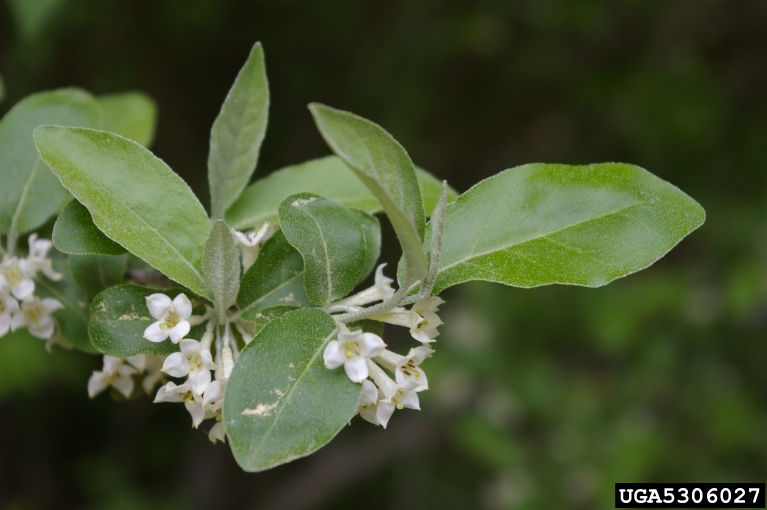
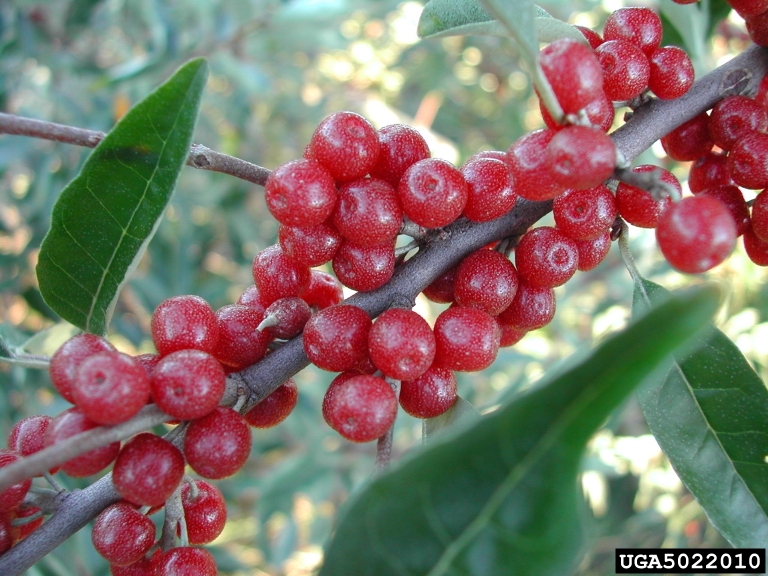
Description
Deciduous bushy shrub to 6 m tall with thorny branches. Leaves alternate, short-stalked, elliptic, 5-8 cm long, margins entire or wavy, silver scaly below. Small, white, tubular, fragrant flowers in clusters. Fruit a showy red berry dotted with silvery scales.
Habitat
Forest openings and open forests
Comments
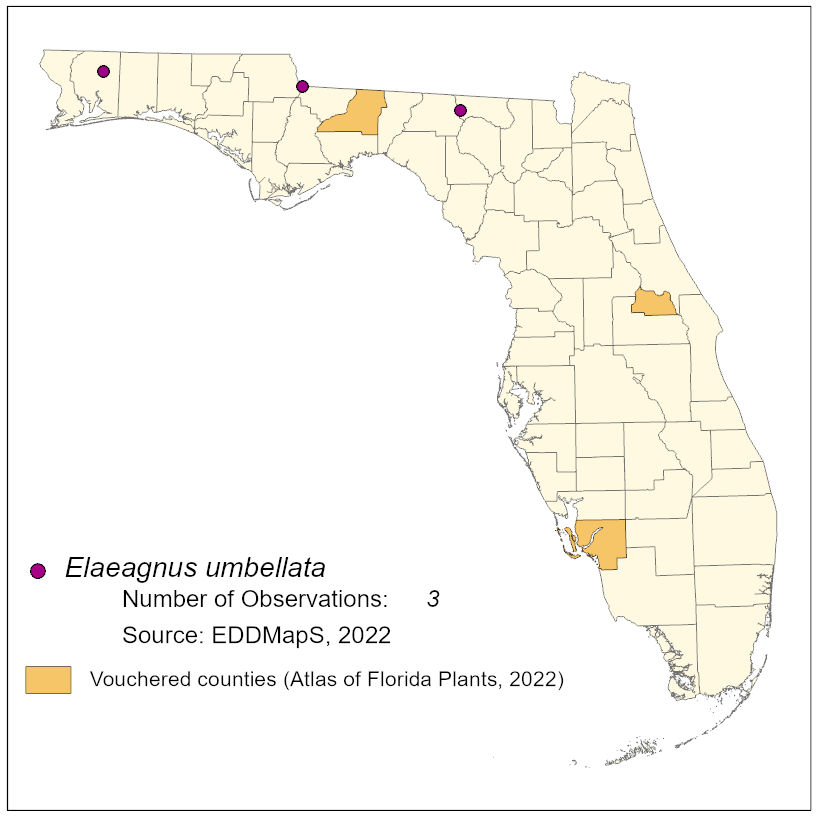
Widely established in natural areas in Georgia and to north. Seeds dispersed by mammals and birds.
Control Methods
- Manual: NA
- Chemical: Foliar (1% imazapyr), basal bark (20% triclopyr ester), cut-stump (5% imazapyr or 20% glyphosate, Miller et al.)
- Biological: NA
Control Notes
Note: Bag and remove all fruits during removal projects
References
Dave's Garden. 2013. PlantFiles: Autumn olive, Elaeagnus umbellata. http://davesgarden.com/guides/pf/go/32215/. Accessed on December 9, 2013.
Miller, J.H., E.B. Chambliss, and N.J. Loewenstein. 2010. A Field Guide for the Identification of Invasive Plants in Southern Forests. U. S. Department of Agriculture, Southern Research Station. Asheville, NC.
Miller, J.H., S.T. Manning, and S.F. Enloe. 2010. A Management Guide for Invasive Plants in Southern Forests. U. S. Department of Agriculture, Southern Research Station. Asheville, NC.