
Megathyrsus maximus
Common Name: Guinea grass
Family: Poaceae
Common Synonyms: Panicum maximum, Urochloa maxima
USDA Hardiness Zone: 8a-11
Growth Habit: Herb
Origin: Africa
FISC Category: 2
FDACS Listed Noxious Weed: No
Introduction Date: Earliest Florida specimen available vouchered in 1933
IFAS Assessment:
- North: CAUTION
- Central: CAUTION
- South: INVASIVE
Description
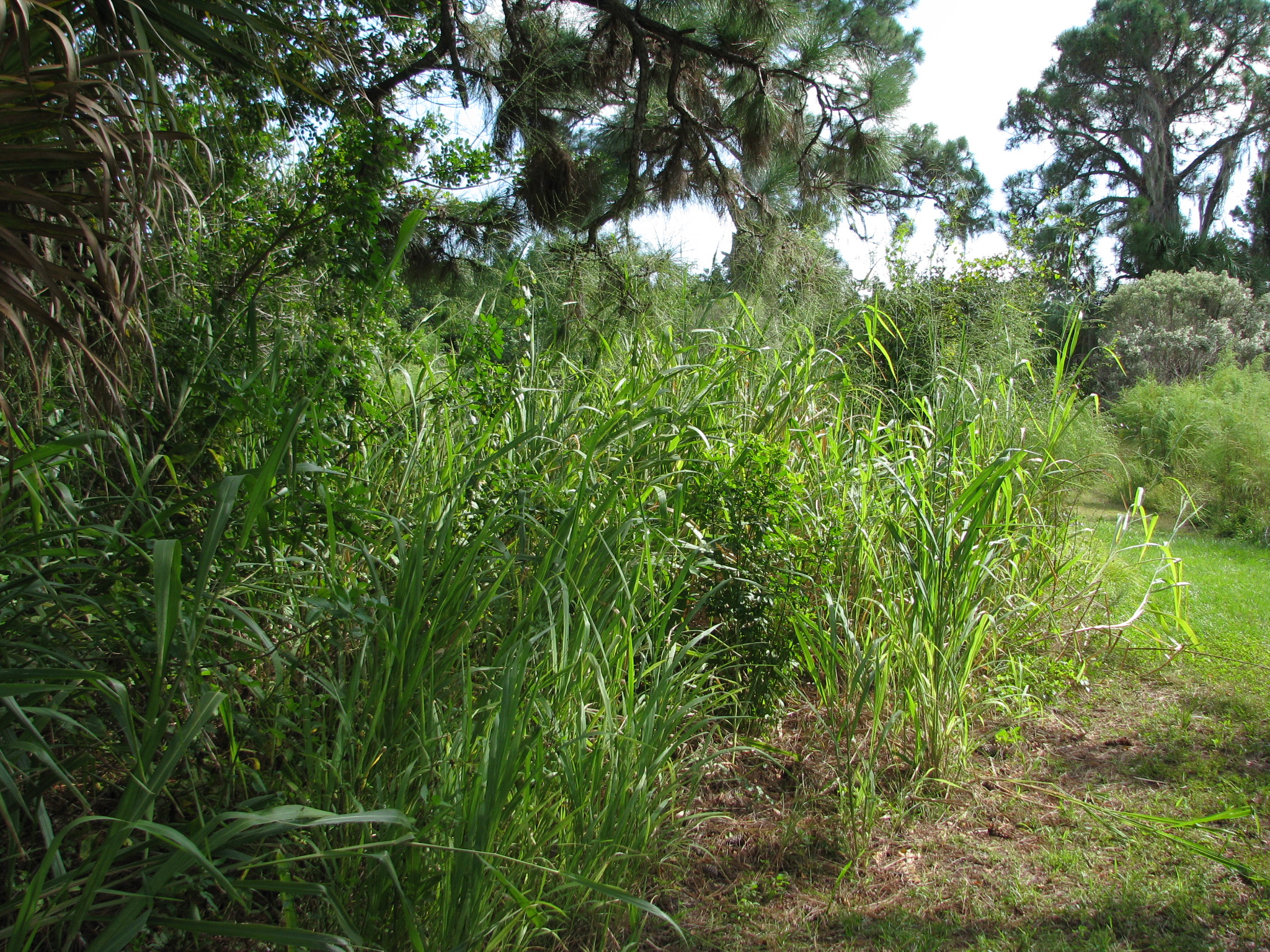
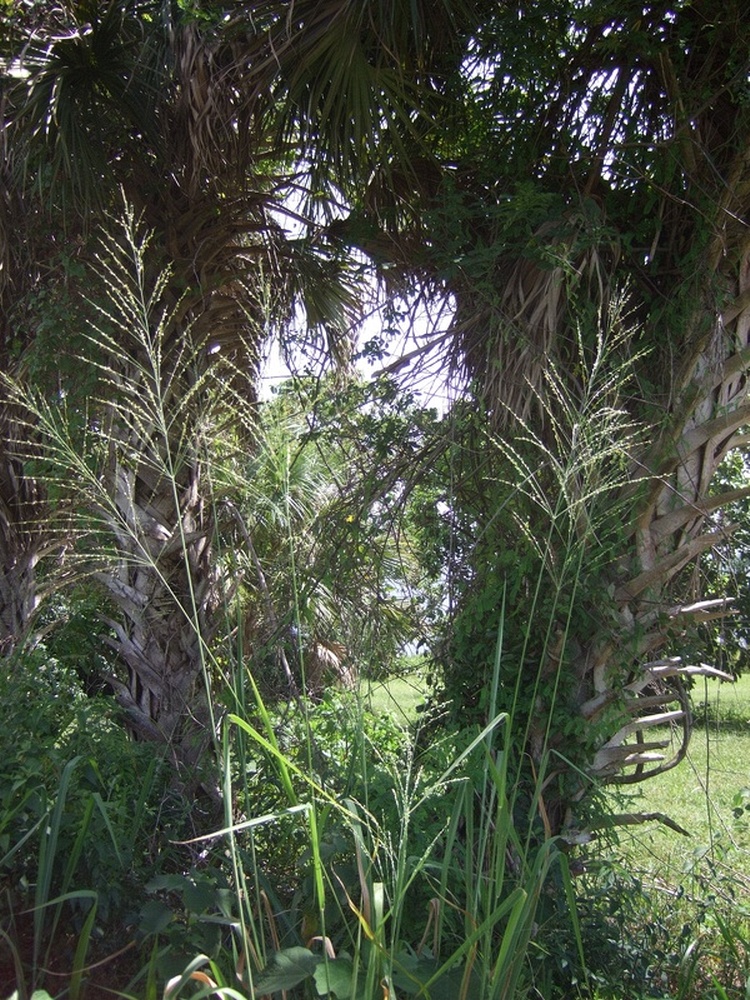
Robust, densely-tufted perennial grass to 3 m tall. Rhizome may bear hairy reduced-leaf remnants. Stem stout, erect, glabrous to hairy, nodes often densely hairy. Leaf sheath glabrous to stiff-hairy, often with dense patches of hair at junction with leaf blade. Ligule membranous, to 6 mm long. Leaf blade flat, linear, to 90 cm long and 3.5 cm wide, glabrous to softly or coarsely hairy on upper surface, margin may be rough to the touch. Inflorescence a many-branched, erect or slightly nodding panicle, to 60 cm tall and 20 cm wide, with 3-7 whorled lower branchlets. Spikelets clustered on branchlets, short stalked, to 4 mm long, green to purplish, oblong, blunt-tipped or slightly pointed, glabrous or slightly hairy, first glume 1/3 length of spikelet, second glume equal length to spikelet, upper floret fertile, developing a dull, white seed.
Habitat
Mesic flatwoods, coastal strand, maritime hammock, xeric hammock, sandhill, scrub, pine rockland.
Comments
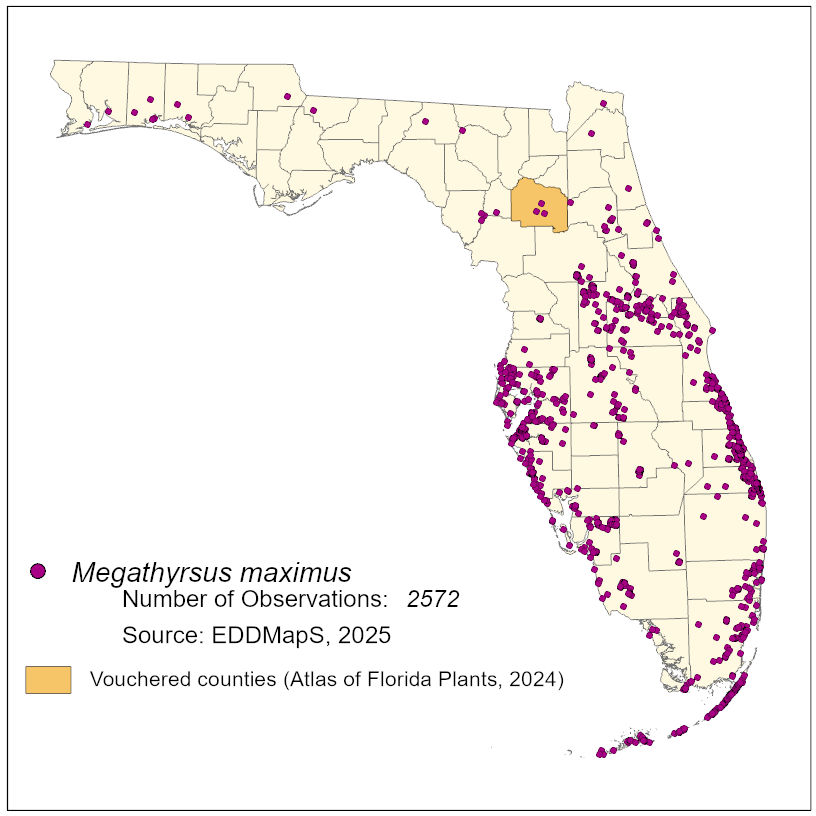
Fast growing. Widely established except in the panhandle.
Control Methods
- Manual: NA
- Chemical: 3-5% Glyphosate foliar, Glyphosate 2% plus Imazapyr 0.5%, or Imazapyr 1-2% yield similar results, retreat at 2-4, 3-5, 4-6 months respectively (IFAS).
- Biological: NA
Control Notes
NA
References
Langeland, K.A., H.M. Cherry, C.M. McCormick, K.C. Burks. 2008. Identification and Biology of Non-Native Plants in Florida's Natural Areas-Second Edition. IFAS Publication SP 257. University of Florida, Gainesville, Florida.
Tropical Forages Fact Sheet. http:/www.tropicalforages.info/key/forages/media/Htmi/Panicum_maximum.htm. Accessed on December 10, 2013.
Dave's Garden. 2013. PlantFiles: Guinea grass, Panicum maximum. http://davesgarden.com/guides/pf/go/59767/. Accessed on December 10, 2013.