
Tribulus cistoides
Common Name: burrnut
Family: Zygophyllaceae
Common Synonyms: none
USDA Hardiness Zone: 9a-11
Growth Habit: Perennial herb
Origin: East Africa, Madagascar, Mascarene Islands
FISC Category: 2
FDACS Listed Noxious Weed: No
Introduction Date: Mid 1940s
IFAS Assessment:
- North: CAUTION
- Central: CAUTION
- South: CAUTION
Description
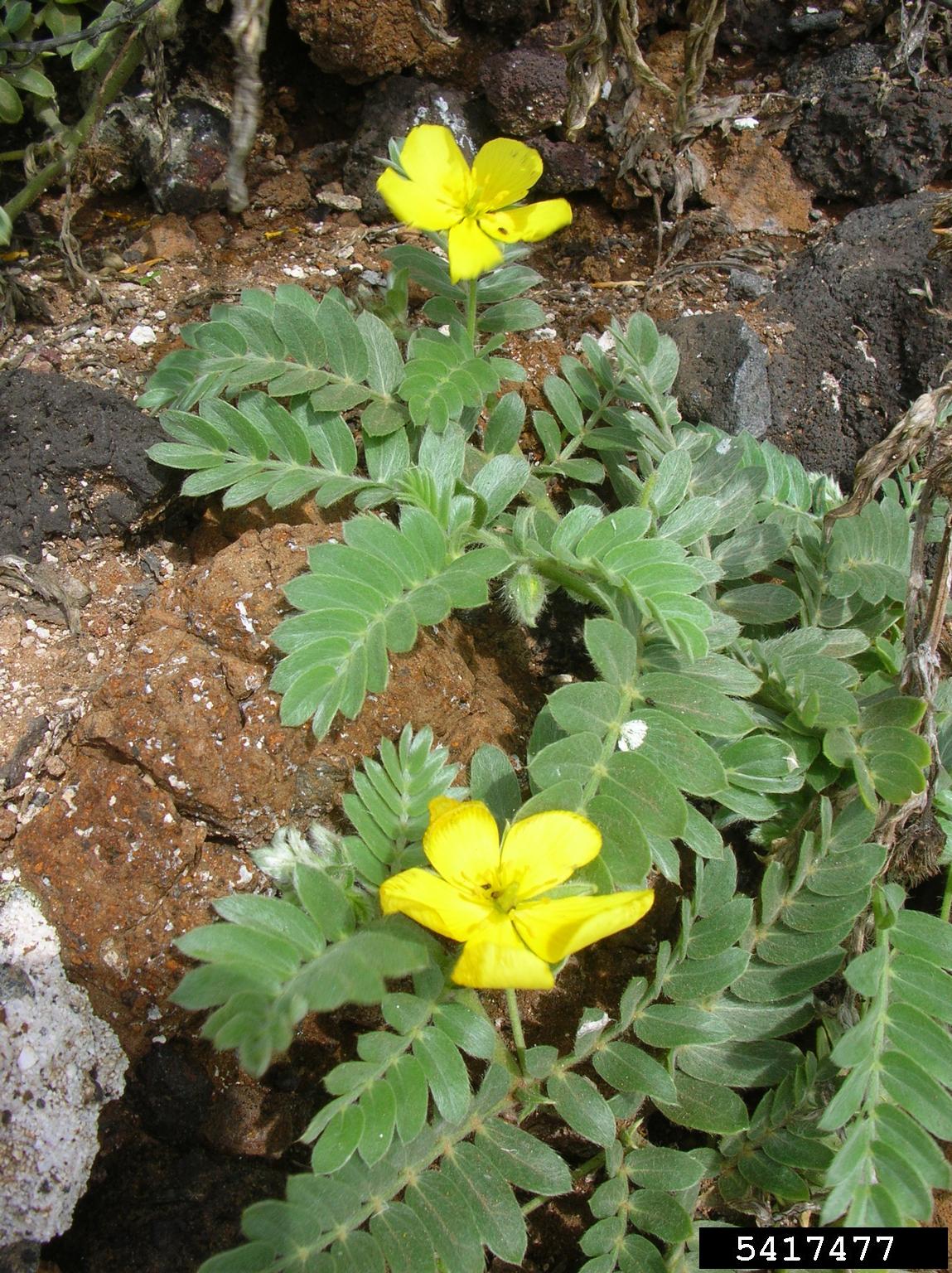
Perennial (sometimes annual) herb, with many-branched trailing stems to 1 m long or longer. Tap root woody, stems often slightly woody at base, tips erect, younger stems covered with silky hairs. Leaves opposite, to 10 cm long, even-pinnate. Leaflets in 5-8 pairs, elliptic or oblong, to 2.8 cm long and 1.2 cm wide, covered with silky hairs, margins entire, bases rounded, tips bluntly pointed. Terminal leaflet pair spine tipped. Stipules linear, to 0.7 cm long. Flowers showy, solitary in leaf axils, on long, hairy stalks 2 to 3 cm long, sepals 5, lance shaped, petals 5, bright yellow, rounded, to 2.5 cm long. Fruit a hard spiny capsule, burr-like, to 1.5 cm across, splitting into 4 or 5 segments, each of which has two sharp spines to 8 mm long and contains one or more seeds.
Habitat
Dunes and coastal strands, sandy openings of ruderal areas and pinelands
Comments
Spiny nutlets are animal and human dispersed.
Control Methods
- Manual: Manual pulling. Mowing is not effective due to the prostrate growth habit.
- Chemical: Glyphosate and dicamba have been used with excellent results. 2,4-D also shows good results. A 1-2% solution of each of these with surfactant is recommended (IFAS) or foliar with 5% triclopyr ester.
- Biological: NA
Control Notes
NA
References
Dave's Garden. 2014. PlantFiles: Burrnut, Tribulus cistoides. http://davesgarden.com/guides/pf/go/103210/. Accessed on June 23, 2014.
Langeland, K.A., H.M. Cherry, C.M. McCormick, K.C. Burks. 2008. Identification and Biology of Non-Native Plants in Florida's Natural Areas-Second Edition. IFAS Publication SP 257. University of Florida, Gainesville, Florida.