
Terminalia muelleri
Common Name: Australian almond
Family: Combretaceae
Common Synonyms: none
USDA Hardiness Zone: 10b-11
Growth Habit: Tree
Origin: Australia
FISC Category: 2
FDACS Listed Noxious Weed: No
Introduction Date: pre 1942
IFAS Assessment:
- North: CAUTION
- Central: CAUTION
- South: CAUTION
Description
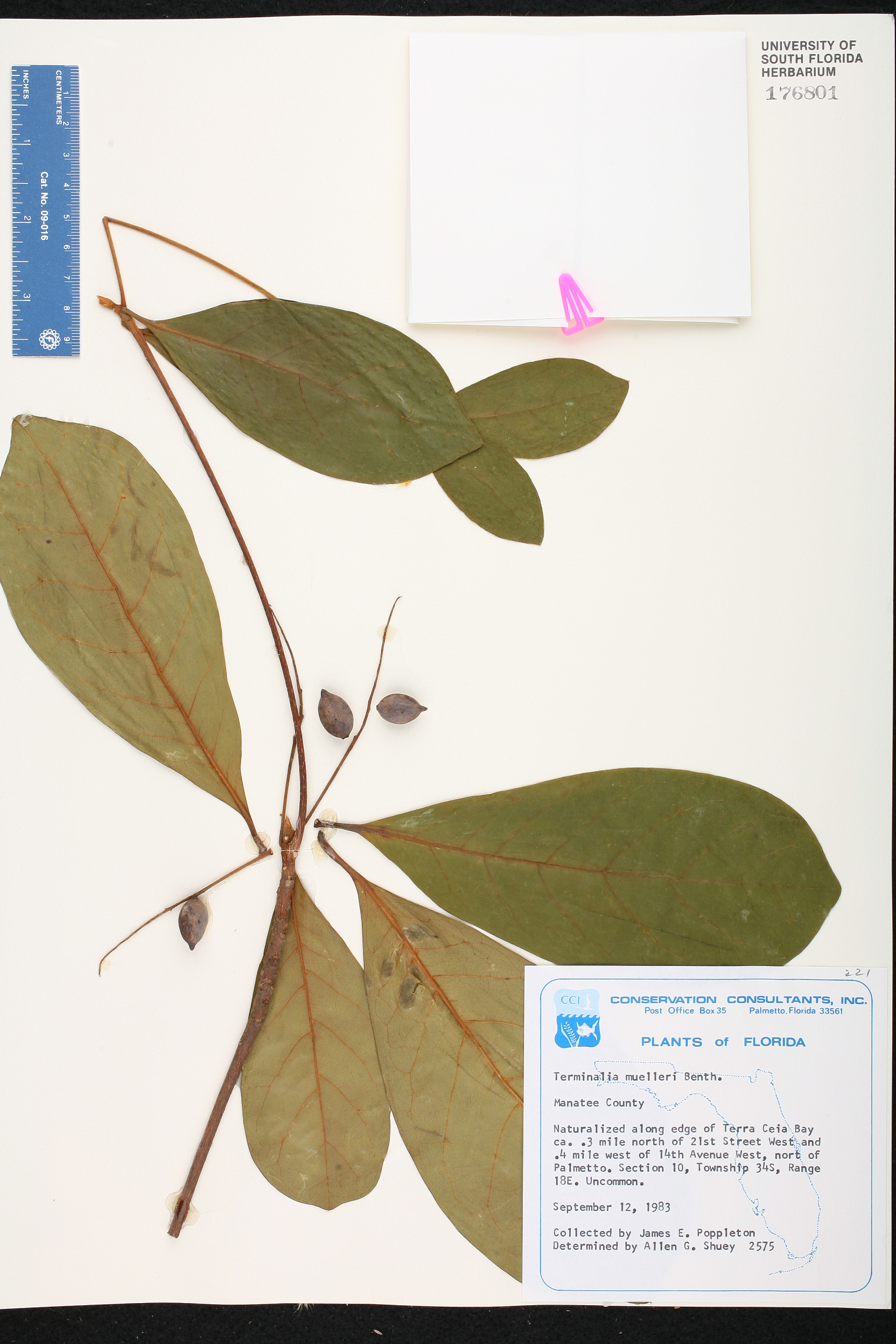
Deciduous tree to 15 m tall. Branches conspicuously whorled and horizontally tiered. Leaves simple, alternate, obovate, clustered on twigs, to 15 cm long and 8 cm wide, dark green, turning vivid red prior to leaf fall (usually at least one red leaf present). Lateral veins prominent, in 6-9 pairs. Margins entire, bases wedge shaped, apex broad, rounded, petiole to 1.3 cm. Inflorescence a slender, open, many-flowered spike, shorter than the leaves. Flowers small, white, petals lacking. Fruit a firm, fleshy drupe, ellipsoid, purplish-blue with a whitish bloom when mature, to 2 cm long and 1.3 cm wide, 1 seeded. Seed 1.3 cm by 1.0 cm. Resembles Terminalia catappa in habit, but smaller.
Habitat
Rockland and coastal hammocks
Comments
Flowers and fruits all year. Seeds dispersed by water and animals. Resembles Terminalia catappa in habit, but smaller.
Control Methods
- Manual: Manual: hand pull seedlings.
- Chemical: Basal bark: 10% Garlon 4. Cut stump: 50% Garlon 3A.
- Biological: NA
Control Notes
NA
References
Barrett, M. F. 1956. Common Exotic Trees of South Florida (Dicotyledons). University of Florida Press. Gainesville.
Langeland, K.A., H.M. Cherry, C.M. McCormick, K.C. Burks. 2008. Identification and Biology of Non-Native Plants in Florida's Natural Areas-Second Edition. IFAS Publication SP 257. University of Florida, Gainesville, Florida.
Langeland, K.A., J.A. Ferrell, B. Sellers, G.E. MacDonald, and R.K. Stocker. 2011. Integrated management of non-native plants in natural areas of Florida. EDIS publication SP 242. University of Florida, Gainesville, Florida.